Portfolio · 2023 — 2026

Alexander Solakhyan.
Aerospace & Mechanical

UC Berkeley M.Eng. with hands-on experience in satellite GNC systems, CFD/FEA simulation, and applied machine learning. 

Alexander Solakhyan portrait

About

Engineer first, generalist by training.

I'm an aerospace and mechanical engineer finishing my M.Eng. at UC Berkeley (Class of 2026, GPA 3.9) with a specialization in aerospace engineering. I earned my B.S. in Aerospace & Mechanical Engineering from UC Davis in 2025.

My work spans Satellite GNC, CFD and FEA simulation, Control systems (MPC, LQR, PID, nonlinear), and applied machine learning. My capstone with Airbus U.S. Space & Defense models liquid Xenon propellant slosh in Ansys Fluent and Simulink to support satellite attitude control design.

I speak English, Russian, and Armenian, and I am passionate about chess, with a peak rating of 2000. 

Résumé

Experience, education & skills.

Experience

  1. Sep 2025 — May 2026
    M.Eng. Capstone — Propellant Slosh / GNC
    Airbus U.S. Space & Defense
    Ansys Fluent CFD + Simulink 6DOF modeling of Xenon slosh disturbances for satellite attitude control.
  2. 2023 — 2024
    Undergraduate Researcher — Spin Ice Systems
    UC Davis, Materials Sciences
    Simulated La₀.₇Sr₀.₃MnO₃ nanomagnet arrays in MuMax/Go; designed a 6-bit logic gate from brick-array polarization states.
  3. 2023 — 2024
    Undergraduate Researcher — Crystallography
    UC Davis, Materials Sciences
    Characterized Ta₂O₅ thin-film structure via ParkSystems AFM across deposition methods.

Education

  • 2026
    M.Eng. Mechanical Engineering
    UC Berkeley · Aerospace specialization · GPA 3.9
  • 2025
    B.S. Aerospace & Mechanical Engineering
    UC Davis · GPA 3.5

Toolbelt

PythonC++MATLAB / SimulinkRJavaGoAnsys FluentNASTRAN / PATRANSolidWorksAVLOpenVSPXFoil

Focus areas

· Control systems (MPC, LQR, PID, nonlinear)  · ML ( Adaboost, Random Forest, SVM, CNN)  · Embedded systems  · CAD/CAM

Capstone

UC Berkeley M.Eng. Capstone.

Liquid Xenon Propellant Slosh Dynamics
01 / 062025 — 2026

UC Berkeley M.Eng. Capstone · Airbus U.S. Space & Defense

Liquid Xenon Propellant Slosh Dynamics

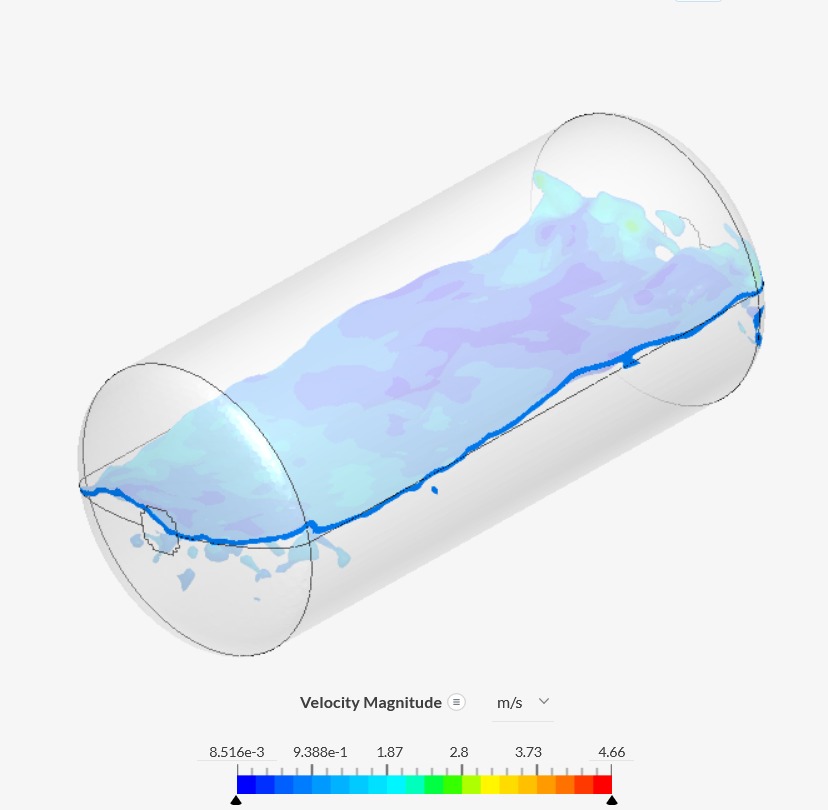
Capstone project with Airbus U.S. Space & Defense: a coupled CFD + 6DOF study quantifying how liquid Xenon slosh in a satellite propellant tank disturbs attitude, position, and torque — used to inform GNC design and slosh-mitigation trade studies.

My contribution

  • Built Ansys Fluent CFD models of the Xenon tank to quantify disturbance forces across a range of acceleration profiles.
  • Developed a Simulink 6DOF simulation coupling slosh forces into satellite attitude, position, and torque states.
  • Identified worst-case operating conditions and characterized sensitivity of GNC performance to tank fill fraction.
  • Presented findings to the cross-functional GNC team, enabling informed trade-offs on slosh feasibility and propellant energy reduction.
Ansys FluentSimulinkMATLAB6DOF

Senior Design

UC Davis B.S. Senior Design.

Canard Agricultural Aircraft — Full Design & Stability Analysis
02 / 06Jan — Jun 2025

UC Davis · B.S. Senior Design

Canard Agricultural Aircraft — Full Design & Stability Analysis

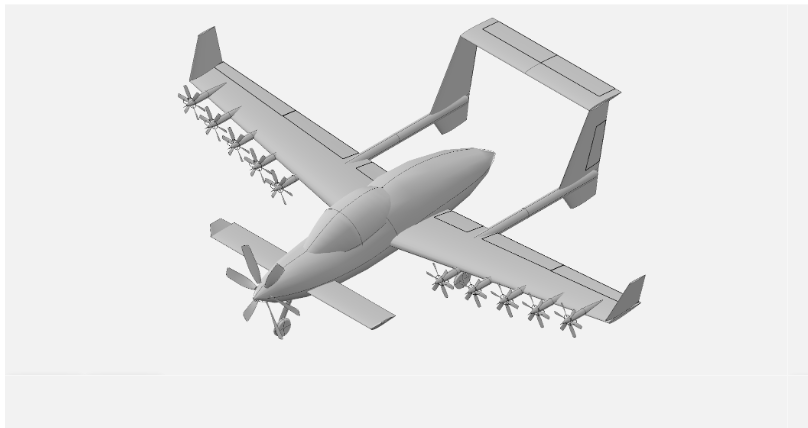
Two-quarter senior design project: a full conceptual design of an agricultural aircraft, covering static stability, power, electronics, and aerodynamics. As an individual extension, I performed a dynamic stability analysis to characterize how an added forward canard shifts the aircraft's flight modes versus the baseline tail-only configuration.

My contribution

  • Contributed to the team-wide design across static stability, power, electronics, and aerodynamics, documented in the Critical Design Review.
  • Built the airframe geometry in OpenVSP and ran AVL to extract stability and control derivatives across the flight envelope.
  • Led the individual dynamic stability study, solving the linearized equations of motion in Python to compare mode shapes and damping with and without the canard.
  • Documented the trade-offs of the canard configuration for low-speed agricultural operations.
AVLOpenVSPPythonXFoil

Selected coursework

Graduate Coursework Projects.

Model Predictive Controller that plans the shortest feasible multi-point turn for a car-like vehicle, subject to kinematic and steering-rate constraints. Produces smooth trajectories that respect both hard and soft bounds.

My contribution

  • Formulated the nonlinear vehicle kinematics and discretized the dynamics for a finite-horizon MPC.
  • Implemented the controller in Python with hard constraints on heading/position and soft constraints on steering effort.
  • Tuned cost weights to minimize total turn distance while keeping trajectories smooth and feasible.
  • Validated convergence across a sweep of road widths and initial poses.
PythonMPCCVXPYNumPy

Nonlinear controller for the powered descent and landing of a rocket booster, layering gain-scheduled P guidance, sliding-mode tilt control, and a time-optimal bang-bang recovery mode.

My contribution

  • Built vertical and horizontal guidance with altitude-tiered, gain-scheduled P control blended smoothly across flight regimes.
  • Designed a sliding-mode + PD body-attitude controller with a saturation-smoothed switching term to suppress chattering.
  • Added a time-optimal bang-bang recovery mode using a θ̇² vs. θ_err switching curve for max-torque braking when far from the surface.
  • Implemented an open-loop upside-down recovery state machine that pre-positions the gimbal before applying scaled thrust to flip the rocket.
MATLABSimulinkNonlinear Control6DOF

Documents & code

Derived and implemented a Kelvin–Voigt finite element model to simulate time-dependent stress–strain behavior of viscoelastic materials, validated against analytical solutions.

My contribution

  • Led the Derivations of the Kelvin–Voigt constitutive equations and the corresponding weak form for FEM.
  • Implemented the element and time-integration scheme from using Fortran-based simulations.
  • Validated transient stress–strain response against closed-form analytical solutions on benchmark loadings.
  • Documented convergence behavior under mesh and time-step refinement.
MATLABFEMViscoelasticity

Documents & code

Graduate seminar deriving generalized continuum theories from the Principle of Virtual Power, and showing how relaxing classical assumptions leads to four progressively richer plasticity frameworks.

My contribution

  • Introduced the Principle of Virtual Power through Conventional Plasticity, deriving the kinematic split and macroscopic/microscopic force balances.
  • Extended the framework to Strain-Gradient (Aifantis) and Gurtin–Anand theories, introducing nonlocality and tensorial gradient hyperstresses.
  • Closed with Micromorphic Theory, adding third-order micro-stresses and a higher-order balance for deformable micro-volumes.
Virtual PowerPlasticityContinuum Mechanics

Documents & code

Undergraduate research

UC Davis · Materials Sciences.

2023 — 2024

Artificial Spin Ice — 6-Bit Logic Gate

UC Davis · Materials Sciences

Investigated La₀.₇Sr₀.₃MnO₃ nanomagnet arrays to lay the groundwork for a replicable six-bit logic gate system built from artificial spin ice structures.

Highlights

  • Developed custom GoLang scripts driving the MuMax physics simulator to model energy states across a wide range of structural permutations.
  • Identified low-energy configurations to predict long-term equilibrium and balancing behavior of the arrays.
  • Expanded beyond traditional two-polarity models by simulating brick-like arrays with six possible polarities and multiple chiral states.
  • Established a simulation framework for designing a replicable six-bit logic gate from spin-ice polarization states.
MuMaxGoMicromagnetics
2023 — 2024

Ta₂O₅ Thin-Film Characterization

UC Davis · Materials Sciences

Entrusted with private lab access to independently run the end-to-end characterization of Tantalum Pentoxide (Ta₂O₅) thin films grown by different deposition methods.

Highlights

  • Logged 100+ hours of hands-on time on a ParkSystems Atomic Force Microscope analyzing how growth method shaped crystalline structure.
  • Owned the full procedure end-to-end: lab operations, sample lifecycle, AFM imaging, and data synthesis.
  • Compared surface morphology and grain structure across deposition methods to isolate growth-driven structural differences.
  • Synthesized findings into presentation-ready results for the research group.
AFMThin FilmsCrystallography